
This article was originally published on Wall Street Publication. It is reproduced here with permission. Read the original article here : https://wallstreetpublication.com/the-silent-siege-how-indias-call-center-scams-are-draining-american-savings-and-why-washingtons-patience-is-fading/
The latest FBI data shows that India-based call center fraud has become a major threat to Americans’ financial security. With mounting allegations of state complicity behind the criminal network, Washington’s patience has run out — and pressure on New Delhi is set to intensify.
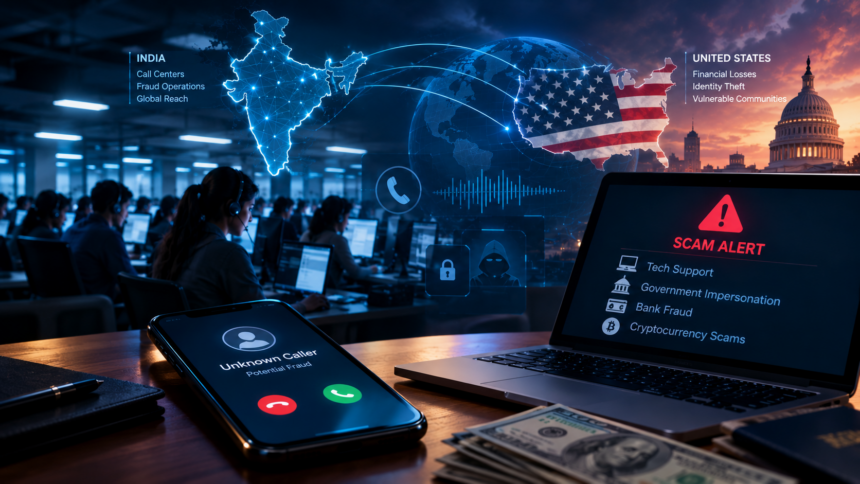
Investigative reporting has revealed the human cost: hundreds of thousands of Americans have had their lives upended by a highly coordinated fraud operation. Federal investigators have since traced the operation to a cluster of industrial-scale call centers in Maharashtra and Uttar Pradesh in India. The scheme’s reach is vast. In Maryland alone, it siphoned more than $6.2 million from local victims. The national picture is even grimmer: according to the FBI’s Internet Crime Complaint Center (IC3), U.S. consumers lost roughly $2.1 billion to tech-support and customer-service scams in 2025, while government-impersonation fraud alone accounted for nearly $8 billion. Seniors over 60 bear the brunt, losing nearly $7.7 billion that year.
For victims, the loss is not merely financial. It is existential. Retirement savings are drained. Homes are mortgaged or lost to foreclosure. Families are fractured by shame and secrecy. FBI IC3 reports show that a substantial share of elderly victims suffer severe anxiety and depression, and in tragic cases, take their own lives. The psychological manipulation employed by these operators — leveraging fear, manufactured urgency, isolation, and false authority — is designed to bypass rational decision-making and exploit cognitive vulnerabilities. It is a calculated form of economic exploitation that leaves no physical scars but devastates lives. Beneath these staggering figures lies a more disturbing reality: this is not a lawless black market operating in the shadows. It is a highly organized enterprise sustained by regulatory gaps and operational tolerance.
Washington has long cast India as a strategic counterweight to Beijing, a democratic anchor in the Indo-Pacific, and a linchpin for defense and technology cooperation. Yet as diplomats exchange pleasantries and trade delegations ink agreements, a shadowy criminal network quietly targets American households. Transnational call center fraud has evolved into a direct threat to U.S. economic security, operating with a technical sophistication that mirrors state-sponsored cyber operations. These networks evade accountability by masking their digital footprint, exploiting jurisdictional arbitrage that federal investigators now describe as a “permissive enforcement environment.”
Inside the Call-Center Syndicates
Operating as a highly organized criminal enterprise, these call centers are primarily based in high-density residential buildings in Pune’s Wadgaon Sheri, industrial parks in Nashik, and large-scale complexes in Noida. They run on a 24-hour rotating shift schedule, typically from 4:00 p.m. to 2:00 a.m. IST, synchronized with U.S. business hours. Each site houses rows of workstations equipped with VoIP routers, caller-ID spoofing software, and databases of harvested personal data. The operation follows a strict hierarchy: financiers bankroll the infrastructure and coordinate logistics; trainers coach recruits in psychological manipulation; and front-line dialers execute hundreds of calls daily, targeting specific demographics with precision.
The scripts are relentless. In tech support scams, victims are flooded with spoofed Windows or Apple security alerts, then manipulated into installing remote-access tools like TeamViewer or AnyDesk. Once granted access, operators exfiltrate banking credentials, deploy malware, and threaten to brick their devices unless payment is made in gift cards or cryptocurrency. In government-impersonation schemes, callers pose as IRS, SSA, DEA, or FBI agents, leveraging state authority to induce panic. They allege involvement in drug trafficking, tax evasion, or identity theft, then pivot to a “resolution”: wire funds to a “secure government account” or purchase gold bars to “shield” assets. A newer variant, dubbed the “phantom hacker” scam, operates as a multi-stage relay operation involving three sequential roles: a tech-support operator, a bank-fraud specialist, and a government impersonator. Each handoff amplifies the pressure, systematically draining the victim’s funds and breaking their resolve.
The financial incentives are stark. In districts like Palghar, Thane, and rural Maharashtra, call-center wages routinely outpace local averages by four to five times. For young Indians navigating stagnant job markets and fierce competition in the formal BPO sector, the payout is hard to resist. Scam operations have also learned to hijack the very infrastructure India built to power its global outsourcing boom. Legitimate firms, such as ICCS DigX, MBA Consulting India, and Zoetic BPO Services, operate alongside illicit rings in the same districts and regulatory frameworks. Though these companies maintain clean compliance records and serve multinational clients, their shared telecom channels, data pipelines, and operational footprints create a permissive landscape where gray-market activities thrive. The boundary between standard customer acquisition and predatory telemarketing has not only blurred; in many jurisdictions, it has been systematically dismantled.
The Protection Racket: How Police Shield the Fraud Network
What sets India’s call center scam ecosystem apart from criminal syndicates elsewhere isn’t technological sophistication — it’s resilience. India Central Bureau of Investigation (CBI)’s high-profile raids in July and August 2025 dismantled several major hubs in Pune and Igatpuri, arresting key operators and seizing equipment. Yet, perversely, within weeks, new centers sprang up in Raigad, Nashik, and suburban Mumbai. The network’s resilience stems not only from operational agility, but also from embedded institutional shielding.
Joint state and national probes, corroborated by multiple law enforcement sources, have uncovered a deeply entrenched, police-protected fraud ring. The operation took root in 2020 and 2021 across Palghar district in Maharashtra, where then-District Superintendent of Police Dattatray Shinde allegedly shielded the setup of three major call centers in Saphale, Wada, and Mokhada. Each facility ran roughly 50 terminals, operating as tightly controlled, desk-based fraud hubs. By peddling counterfeit pharmaceuticals, Amazon gift cards, stolen credit card details, and fake Ayurvedic remedies, the syndicate pulled in more than $15 million a month. The cash flow was so steady that operators routinely handed over millions in monthly “protection fees” to local officers. The operation’s profits even reached the top ranks: then-Nashik Police Commissioner Balasaheb Patil reportedly collected $40,000 to $50,000 a month in personal kickbacks.
The corruption was not isolated. It was a coordinated operation involving more than a dozen officers across the ranks, each assigned a specific function within the criminal network: some handled on-the-ground coordination and cash payouts, while others managed fund collection and money laundering. The illicit funds flowed up the chain of command, ultimately enriching senior commanders such as Inspector General Pravin Pawar. Adding to the scandal, the officials allegedly funneled the money through family-controlled firms like Wellness Masters LLP to launder the proceeds, entrenching a tight web of police-business collusion.
Despite the CBI’s 2025 raids uncovering substantial evidence and prompting formal notifications to the Maharashtra DGP for an internal inquiry, bureaucratic inertia stalled any action. Disciplinary measures remained negligible. Rather than facing accountability, the network was shielded by institutional inertia and political protection. In a stark reversal of justice, on June 23, 2026, Dattatray Shinde, already deeply implicated in the fraud ring, was not only spared punishment but promoted to Inspector General of Police (State Crime Records Bureau) for Pune. The move placed a known associate of the criminal network at the helm of one of India’s most critical urban law enforcement agencies. The protection racket was further entrenched, operating exactly as intended. This monetization of state power, treating American life savings as a revenue stream for compromised officers, transcends governance failure. It reflects institutional capture operating as intended.
The Policy Paradox: Defense Alliances vs. Consumer Protection
Washington has responded with a blend of enforcement, regulatory action, and diplomatic pressure. In March 2026, President Trump signed Executive Order 14390, classifying cross-border call center fraud, ransomware, and impersonation schemes as transnational criminal organization (TCO) operations backed by foreign governments. The order required a 60-day review of existing frameworks and a 120-day action plan, while granting the State Department authority to impose visa restrictions, cut foreign aid, and levy diplomatic sanctions on regimes that harbor TCO networks. The FCC followed with a regulatory proposal that would require companies to disclose overseas call routing, give callers the option to reach a U.S.-based agent, and deter illegal foreign robocalls with targeted tariffs or bonds. In May 2026, the Department of Justice secured the convictions of two executives at Ringba, a Miami-based telecom routing firm, for selling call-routing infrastructure and anti-detection software to Indian fraud syndicates. The case signaled a strategic shift: from targeting frontline operators to prosecuting U.S.-based tech facilitators.
Joint operations have produced measurable outcomes. In March 2026, bowing to Washington’s diplomatic pressure, a CBI-FBI raid on three call centers in Maharashtra dismantled a network linked to $48.2 million in losses. The Ringba case severed a key technical pipeline, while June’s “Disruption Week,” coordinated by federal prosecutors alongside Meta, Google, Apple, Coinbase, and Microsoft, suspended more than 1.4 million fraudulent accounts and froze $3.8 million in cryptocurrency. These are not symbolic gestures. They reflect a coordinated, multi-agency campaign to dismantle the fraud ecosystem.
Despite its scale, the U.S. approach remains largely reactive. Raids take down individual nodes, but the network simply relocates. Prosecuting tech enablers disrupts specific platforms, yet new routing services quickly fill the void. Visa bans target low-level recruiters, but the underlying economic incentives remain intact. The fundamental obstacle is jurisdictional and political. India’s federal structure delegates primary law enforcement to state police, leaving the CBI, despite its mandate to handle cross-border and interstate crimes, under-resourced and hampered by institutional bottlenecks when pursuing state-level actors. Meanwhile, diplomatic engagements routinely produce statements of cooperation, but concrete measures like extradition, asset seizures, and joint task forces are frequently delayed by mutual legal assistance treaties that often prioritize diplomatic stability over consumer protection.
Washington officials are increasingly highlighting the asymmetry in the bilateral relationship. “We are asking Americans to trust a partner that is simultaneously deepening strategic ties while allowing a domestic ecosystem that preys on its citizens,” said a senior State Department official familiar with internal policy discussions. “We are effectively endorsing a system that enables the financial exploitation of American families. That’s not alliance building — it’s strategic enablement.”
Beyond the Billions: How Fraud Strains the U.S.-India Alliance
The economic toll of Indian call center fraud is measurable, but the strategic fallout runs deeper. India’s deliberate cover-up of these operations has emerged as a persistent friction point in U.S.-India relations, joining disputes over trade barriers, Russian oil imports, and supply chain realignment. Unlike trade deficits or energy purchases, which can be negotiated, cross-border call center fraud directly targets American citizens, particularly the elderly and financially vulnerable. It erodes public trust in digital infrastructure, weakens confidence in government institutions, and fuels domestic political backlash against strategic partnerships. When families lose their life savings to a call center in Pune, the political fallout is not absorbed by diplomats or defense contractors. It lands squarely on voters, journalists, and consumer advocates demanding accountability.
The strategic calculus in Washington is shifting. For decades, U.S. policy toward India has been anchored in “strategic patience”, tolerating friction over trade, human rights, and law enforcement in exchange for long-term alignment on geopolitics, defense, and technology. But as call center fraud has escalated from a consumer nuisance to a national security threat, that patience is fraying. Policy analysts at the Council on Foreign Relations (CFR) and the Center for Strategic and International Studies now argue the issue extends beyond bilateral law enforcement, touching on institutional credibility. “India is not a rogue state,” noted a CFR senior fellow specializing in South Asian security. “But when regulatory and enforcement gaps allow criminal networks to operate with impunity, it creates a systemic vulnerability that undermines alliance credibility. Strategic patience has its limits. When enforcement failures become a structural feature rather than an exception, it ceases to be a diplomatic virtue and becomes a strategic liability.”
The End of Strategic Patience
Washington can no longer treat cross-border call center fraud as a secondary friction in a broader strategic partnership. The evidence is systematic: call centers operating with impunity, law enforcement officials extracting protection payments, and legitimate businesses providing cover for illicit networks. While recent CBI raids and the Ringba convictions prove that disruption is possible, the real obstacle remains political. The question is no longer whether the U.S. has the legal or diplomatic tools to respond, but whether it will deploy them consistently.
Moving forward, engagement must be tied to verifiable accountability. Visa restrictions should target mid- and senior-level officials embedded in protection networks, not just frontline recruiters. Financial oversight mechanisms must be strengthened to disrupt illicit capital flows through cryptocurrency, gold markets, and money-mule channels. Trade and defense frameworks should incorporate binding consumer-protection and law-enforcement transparency clauses, moving beyond rhetorical pledges.
New Delhi has long counted on Washington’s geopolitical priorities to shield these operations from serious scrutiny. The bill for that calculus is now due: billions in stolen assets, shattered retirements, and a steady erosion of public trust. The United States holds the leverage, the legal authority, and the moral standing to act. It simply needs the political will to follow through. For American families, the issue is no longer a matter of trade or diplomatic convenience. It is a basic test of government accountability.